DreamLabs
DreamLabs
DreamLabs
[Cost guide]
For founders building a round-up, savings or giving app that links bank accounts and moves money. You'll see every cost line before you build: bank data, ACH and card fees, compliance and per-member running costs, from the providers' own price lists. DreamLabs built Grove, our own round-up app, and builds these apps for founders, starting with a $4,000 two-week strategy sprint; most builds take about 6 weeks after it.
Start with a strategy sprint[At a glance]
| Cost line | Published price | When you pay it | How to keep it down |
|---|---|---|---|
| Bank linking and transactions: Plaid | No per-product prices on its pricing page. Billed one-time per linked account (Auth), monthly per linked account (Transactions) or per call (Balance); up to 200 free live calls per product in Limited Production | Monthly, for every member with a live connection | Remove a member's connection when they leave: the Transactions subscription runs until you do |
| Bank linking and transactions: Stripe Financial Connections | $1.50 per instant verification (micro-deposits free); $0.10 per balance check; $0.30 per institution, per account holder, per month for transactions | At signup, then monthly per linked bank | Check balances right before a pull, not on a timer |
| Collecting round-ups by ACH: Stripe | 0.8% per debit, capped at $5; $4 per failed debit; $15 per dispute | Every pull | Batch spare change into one pull (Grove collects at $5) and check the balance first |
| Cards and wallets: Stripe | 2.9% + 30¢ per domestic card charge | Every charge | Fine for monthly plans and one-time gifts; too costly for $5 pulls |
| Identity checks: Stripe Identity | $1.50 per ID document and selfie check; $0.50 per US SSN lookup | Once per member who needs one | Ask for ID only where your model requires it |
| SMS sign-in codes: Twilio Verify | $0.05 per successful verification + $0.0083 per US text | Every SMS sign-in | Offer Apple and Google sign-in too, as Grove does |
| Backend: Firebase (Blaze plan) | Firestore: 50,000 reads a day free, then $0.03 per 100,000 (us-central1). Cloud Functions: 2 million calls a month free, then $0.40 per million | Monthly, by usage | Read only what each screen shows |
| App stores | Apple Developer Program $99 a year; Google Play $25 once | Yearly, and once | Fixed |
| Compliance | No list price: legal review, a security program and store declarations | Before launch, then as rules change | Settle the money-flow design with a lawyer before it is built |
| Build team: market rates | Clutch: most app projects $10,000–$49,999, at $25–$49 an hour, financial apps included. BLS median developer salary: $135,980 | During the build | Scope the first release to one money flow |
| Build team: DreamLabs | $4,000 two-week strategy sprint, refunded in full if we don't move forward together; your build price is set and approved at the end of it | Sprint first, then the build | The sprint cuts what version one doesn't need |
[Cost drivers]
A round-up app earns trust in small, invisible moments: a purchase rounds up, the spare change adds up, money moves, and the member sees what it did. Each of those moments has a price, set by the bank-data provider, the payment processor and the rules around moving money. Below is each one from the providers' own pages, checked on October 8, 2026, and what we learned building Grove, our own round-up app, which went from idea to both app stores in six weeks.
Round-ups start with transaction data. Plaid doesn't list per-product prices on its pricing page, but it does publish how it bills: a one-time fee per linked account for products such as Auth (account and routing numbers), a monthly subscription per linked account for Transactions, and a fee per successful call for Balance. Sandbox testing is free, Limited Production includes up to 200 live calls per product, and Pay as You Go has no upfront commitment, while the Growth plan asks for 12 months. One line in Plaid's billing docs belongs in every round-up budget: a Transactions subscription keeps charging while the connection exists, even if you make no calls, and it ends only when the connection is removed, by you or by a member who revokes access. Build account deletion and churn cleanup into version one.
Stripe Financial Connections publishes its prices: $1.50 per instant account verification (micro-deposit verification is free), $0.10 per balance check and $0.30 per institution, per account holder, per month for a transaction feed. Whichever you choose, round-ups aren't instant. Plaid checks for new transactions one to four times a day, depending on the bank, so design screens that show progress rather than promise live totals.
Plan calendar time as well as money. Plaid requires OAuth for many of the largest US banks, and some, including Chase and PNC, need a security questionnaire about your company's practices before production access unless you're on a trial plan. Most institutions open within hours of registration; Charles Schwab can take up to five business days.
This is where round-up economics are won or lost. Stripe charges 0.8% per ACH Direct Debit, capped at $5, and 2.9% + 30¢ per domestic card charge. On a $5 pull, that's 4 cents by ACH and about 45 cents by card (our arithmetic). Grove lets round-ups accumulate, and each time they reach $5, Stripe collects that amount by ACH; its monthly plans and one-time contributions are paid with Apple Pay or Google Pay.
Failures cost more than successes. Stripe charges $4 for a failed ACH debit and $15 for a dispute, so one failed $5 pull costs as much as a hundred successful ones. Stripe lists preventing payment failures due to insufficient funds among the uses of its $0.10 balance check, and the check pays for itself whenever more than one pull in 40 would otherwise fail (our arithmetic).
ACH has its own rulebook too. Nacha's rules require anyone originating debits authorized online to run a commercially reasonable fraud-detection system that validates an account the first time it's used. Since June 19, 2026, every non-consumer Originator, third-party service provider and third-party sender must also run risk-based processes to identify ACH entries initiated due to fraud, whatever its volume. Ask your payment processor which of these duties it carries and which stay with you.
Compliance may not show up as a line in a build quote, but it shapes the build. These are the questions to settle with a fintech lawyer while the app is still a plan. This is general information, not legal advice.
The cheapest member to keep is the one whose connection never breaks. Plaid's update mode repairs a broken connection with a short re-authentication when a password changes or consent expires, and for US banks a PENDING_DISCONNECT webhook arrives about seven days before consent ends, so the app can ask the member to reconnect before round-ups stop. Some breaks follow the bank's schedule, not yours: Plaid says existing Bank of America connections are being moved off the old API gradually throughout 2026.
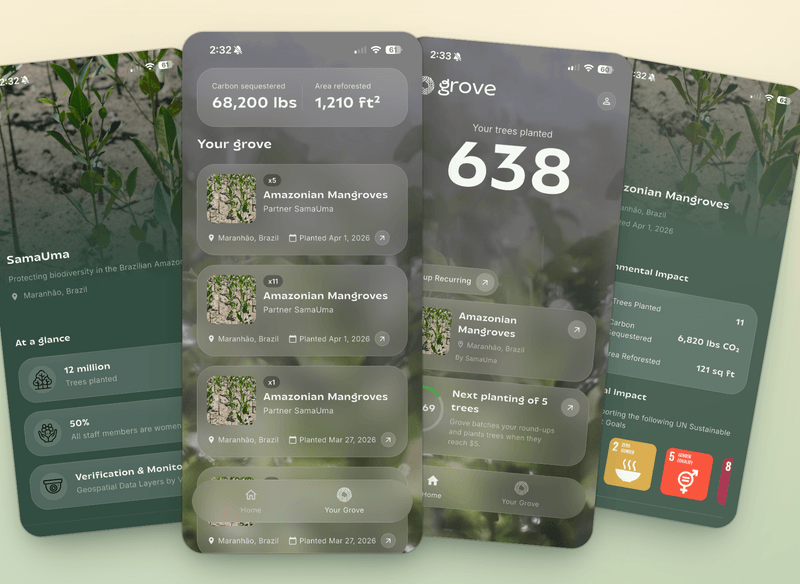
Grove's member screens, as shipped, show what this costs in design: progress toward the next five-tree planting on the home screen, a retry for incomplete plantings, payment-method management and a pause for round-ups at any time. Each one is build time worth budgeting.
Market data for the build is broad. Clutch's pricing guide, drawn from verified client reviews and updated September 21, 2026, lists app development companies at $25 to $49 an hour, financial apps included, puts most app projects at $10,000 to $49,999 and a typical mobile project at about 11 months, and says features, not industry, drive the price. If you hire instead, the BLS median salary for software developers was $135,980 in May 2025, before benefits.
In a round-up app, the features that move an estimate are the money flows. Grove funds trees three ways: round-ups from linked cards, a monthly plan of 5, 10 or 20 trees, and one-time contributions. Every flow adds screens, failure handling and support work, so a first release with one flow costs less and teaches you sooner.
Per-member costs are what your business model has to beat. An example with published prices: a member whose round-ups total $20 a month, linked through Stripe Financial Connections, costs $0.30 for the transaction feed plus $0.16 in ACH fees for four $5 pulls, about $0.46 a month, or $0.86 with a balance check before each pull, after a one-time $1.50 instant verification (our arithmetic). Fixed costs sit on top: the Apple Developer Program at $99 a year, Google Play's $25 one-time registration, SMS sign-in codes through Twilio Verify at $0.05 per successful verification plus $0.0083 per US text, and a Firebase bill that starts at no cost and grows with reads, writes and function calls. Then budget for change: by version 1.4.2 on August 13, 2026, Grove's App Store listing showed 12 updates since its February 3 launch.
[How we'd build it]
[01]
Two weeks, $4,000 flat, refunded in full if we don't move forward together. We map every money flow, choose the bank-data and payment providers, list the questions for your lawyer, and leave you with a features table, wireframes for your core flows and the scope of your first release. Your build price is set and approved at the end.
[02]
AI-accelerated development in Flutter on Firebase, or React where it fits, wired to the providers' sandboxes before any real money moves. We test on real devices, including bank linking, failed pulls and reconnects.
[03]
Production access with your bank-data provider, the app stores' review and declarations, then a launch to members linking their own banks, with user testing included as a free bonus.
[04]
Stay on monthly, priced from your roadmap, to improve sign-up and retention, or hand the product to your own team. Either way you own the code, the signing credentials and the store accounts.
[Where we fit]
Grove is DreamLabs' own product: our founders, Tomás Quiñonez-Riegos and John Krueger, co-founded it. It rounds up everyday card purchases and turns the spare change into planted trees, and every $5 in round-ups funds five trees with a verified reforestation partner. We took it from idea to both app stores in six weeks, and because it's ours, we also maintain it.
Every project starts with the two-week, $4,000 strategy sprint, and you own every line of code, every signing credential and every store account. Weighing how to build it? Read agency vs freelancer vs in-house.
[Cost and timeline guides]
Still deciding who should build it? Compare agency, freelancer, in-house and fractional paths →
[FAQs]
It depends on how many money flows the first version has, more than on the industry. Clutch's pricing data, from verified client reviews, puts most app projects at $10,000 to $49,999, at $25 to $49 an hour, financial apps included. On top of the build come per-member running costs: bank data (for example, $0.30 per linked bank per month for a transaction feed through Stripe Financial Connections) and payment fees (0.8% per ACH debit, capped at $5). At DreamLabs, every project starts with a two-week strategy sprint for a flat $4,000, refunded in full if we don't move forward together, and your build price is set and approved at the end of the sprint.
Plaid's pricing page doesn't list per-product prices. It publishes the billing models instead: a one-time fee per linked account for products such as Auth, a monthly subscription per linked account for Transactions, and a fee per successful call for Balance. Sandbox testing is free, Limited Production includes up to 200 live calls per product, Pay as You Go has no upfront commitment, and the Growth plan requires 12 months. A Transactions subscription keeps billing until the connection is removed, even if you make no calls.
For small amounts, ACH. Stripe charges 0.8% per ACH Direct Debit, capped at $5, against 2.9% + 30¢ per domestic card charge, so a $5 pull costs 4 cents by ACH and about 45 cents by card. ACH failures are expensive, though: $4 per failed debit and $15 per dispute, so check the balance before you pull. Grove collects round-ups by ACH each time they reach $5 and takes monthly and one-time contributions through Apple Pay or Google Pay.
It depends on whose money moves and through whom, so ask a fintech lawyer before you build. FinCEN treats anyone in the business of transferring funds as a money transmitter, with no activity threshold. If members' money is saved or invested, Apple's App Review Guidelines expect the app to be submitted by the financial institution performing those services. This is general information, not legal advice.
With DreamLabs, the strategy sprint takes two weeks and most builds take about 6 weeks after it; Grove went from idea to both app stores in six weeks. Leave time for provider onboarding: Plaid asks for a security questionnaire before production access to some banks, such as Chase and PNC, and while most institutions open within hours of registration, Charles Schwab can take up to five business days. For comparison, Clutch puts a typical mobile app project at about 11 months end to end.
With published prices, a member whose round-ups total $20 a month costs about $0.46 a month through Stripe: $0.30 for the transaction feed plus four $5 ACH pulls at 4 cents each. A $0.10 balance check before each pull brings it to $0.86, after a one-time $1.50 instant bank verification. Add SMS sign-in codes, backend usage, store fees ($99 a year for Apple, $25 once for Google Play) and support.
Grove's mobile app does: it's a Flutter app on a Firebase backend that moves real money through Plaid and Stripe. The work is in the rules. Firestore Security Rules decide what each signed-in member can read and write, while server code using Firebase's server libraries bypasses them and has to check the caller itself. Our free Firestore security rules checklist covers what to verify.
Every project starts with a two-week strategy sprint for a flat $4,000, refunded in full if we don't move forward together. The sprint delivers a features table, UX wireframes for your core flows and the scope of your first release. Your build price is set and approved at the end of the sprint, and that's what you pay.
[Interested?]